
Never Far Enough
Memories of the Missing and Murdered: True Crime in Fairbanks, Alaska

My Mother shifted her career out of military service and in to the Fairbanks North Star Borough School District in the early 1980s, working first in the school cafeteria until taking on role of Secretary in the attendance and discipline office at Lathrop High School, a place that became a second home to me.
In 1985, she coached the L.H.S. football cheerleaders, serving more as a chaperone than a training coach. As a five-year-old with a Beatles haircut, I had my cheeks pinched and was constantly told how cute I was by pretty girls with big hair.
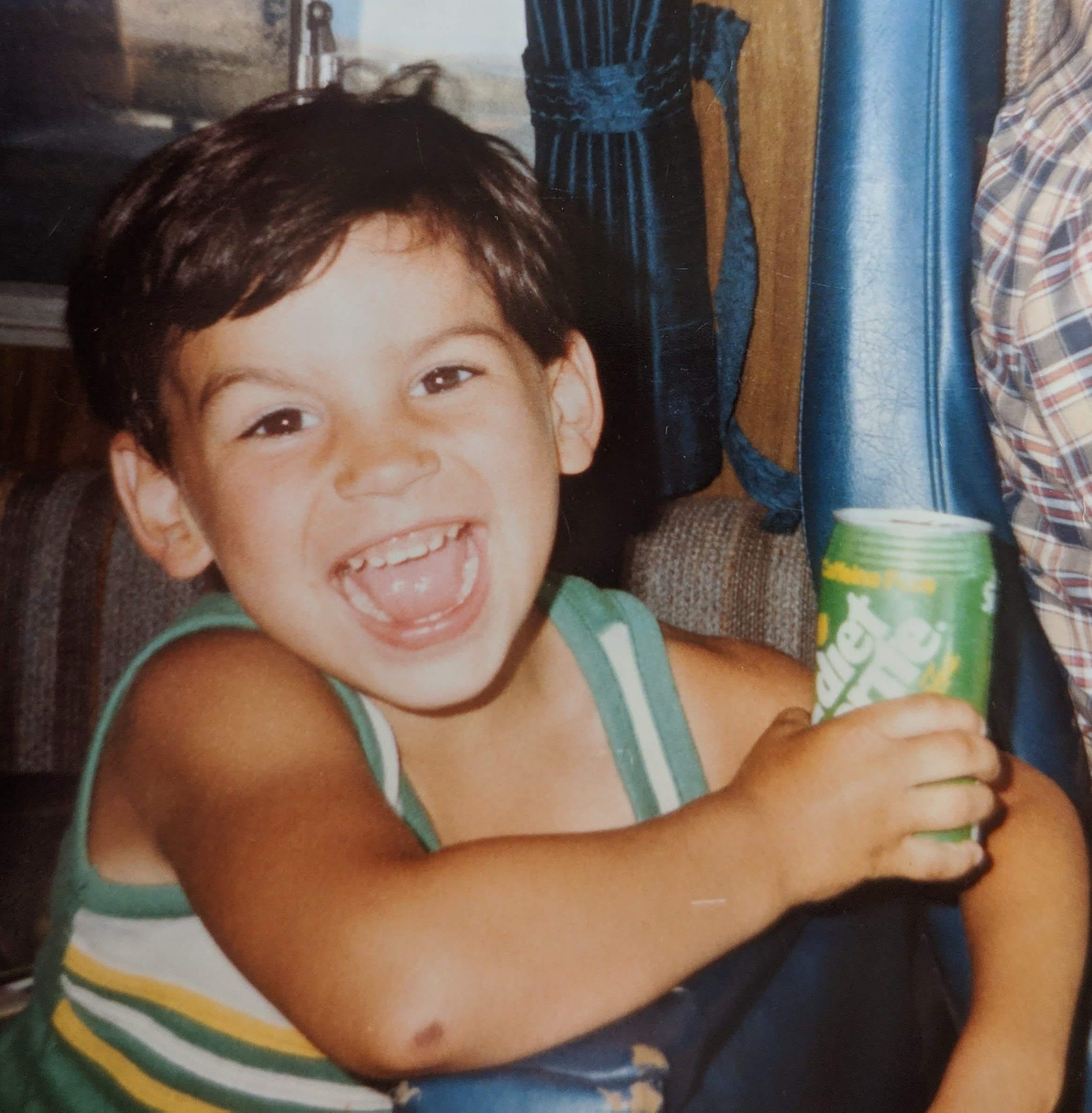
That summer, the song “Money for Nothing” was everywhere, and the football cheerleaders choreographed their halftime dance to the radio cut. I have vivid memories of the team running through their Dire Straits routine in bras and panties while I watched from behind a pile of purple and gold pom-poms, waiting for more adoration.
Growing up around the Lathrop High building as my mom’s tail, I was quiet and always listening to the gossip from students and teachers alike. The office staff preferred Los Amigos for after-work margaritas and nachos, and all the cool teenagers hung out at the new McDonald’s on Airport Road.
If you were in a fight at school, you saw Mom first. When a kid skipped a class or was late, her recorded voice would call his or her parents that night to tell them so. Mom stayed tuned in to the school’s underground radio because kids confided everything to her while waiting for their turn in the Principles office. Whether you came from a troubled home or were a tough kid, she was a trusted person youths went to vent to.
Mom’s office was a hub of teenage drama, which is why when 16-year-old Bryan Perotti told her he was going to kill someone, she dismissed it as teenagers talking shit. She wasn’t the only one. The investigation into Johnny Jackson’s disappearance would uncover that Perotti had repeatedly told many people he would kill the 18-year-old. In Alaska, disappearances were common, and no one took Bryan Perotti seriously.
Alaska had twice the national average of missing persons cases in the 1980s, a distinction it still holds per capita today. At a young age, I knew well that people were disappearing in Fairbanks. In 1990, restaurant billboards across town demanded to know, “Where is Cara Zastrow?”
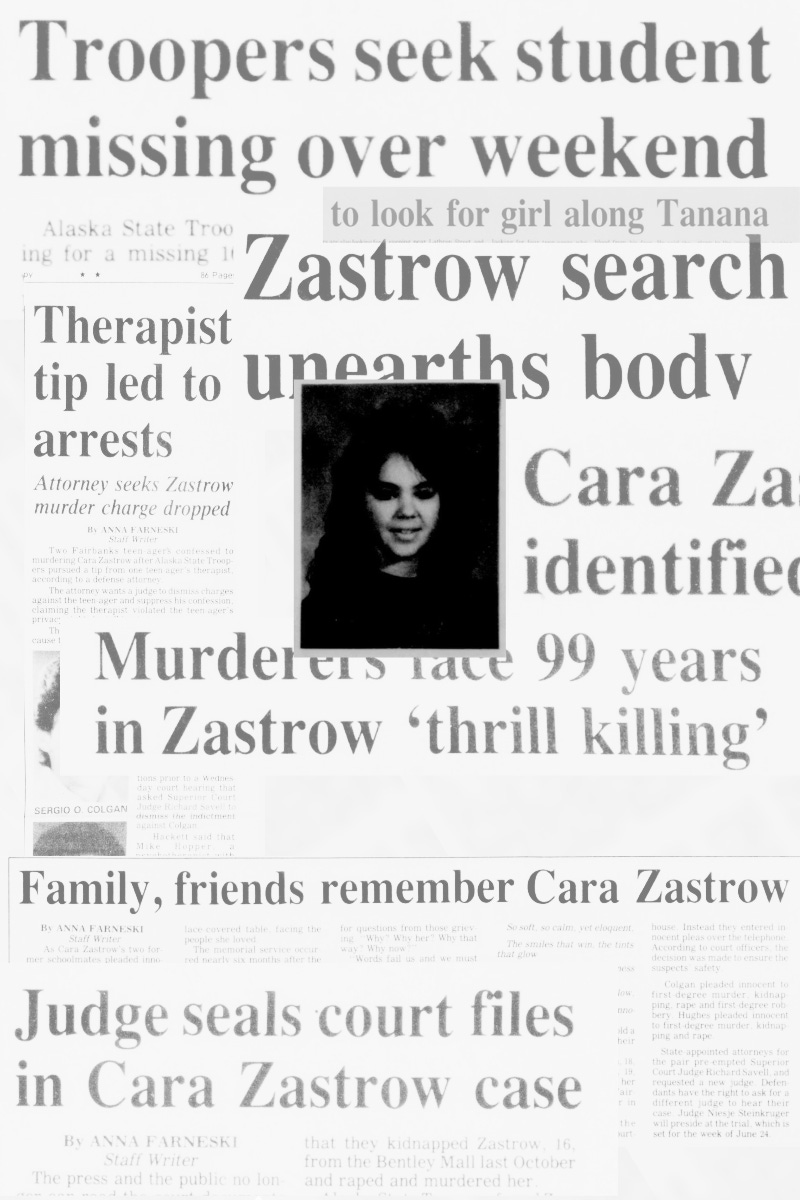
Cara was a 16-year-old West Valley High School student abducted by two men in front of the Bentley Mall, raped and murdered, then hidden under a season of heavy snowfall off 28-mile Chena Hot Springs road.
She was found that summer after her killer’s confessed.
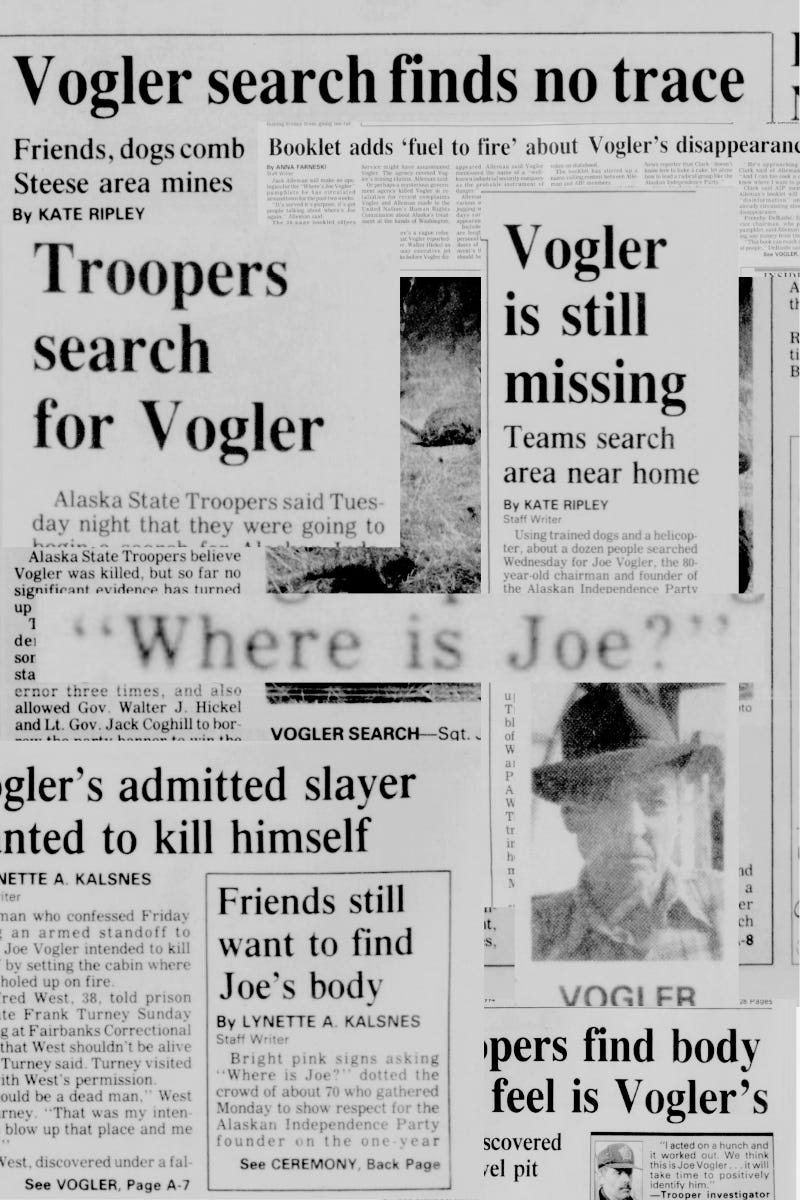
Joe Vogler, founder of the Alaska Independence Party, vanished in early summer 1993, a disappearance that quickly became rife with conspiracy theories. It became common to see bumper stickers and road signs around town asking, “Where’s Joe?”
His body was found in a gravel pit in the fall of 1994, after a confession by his murderer.
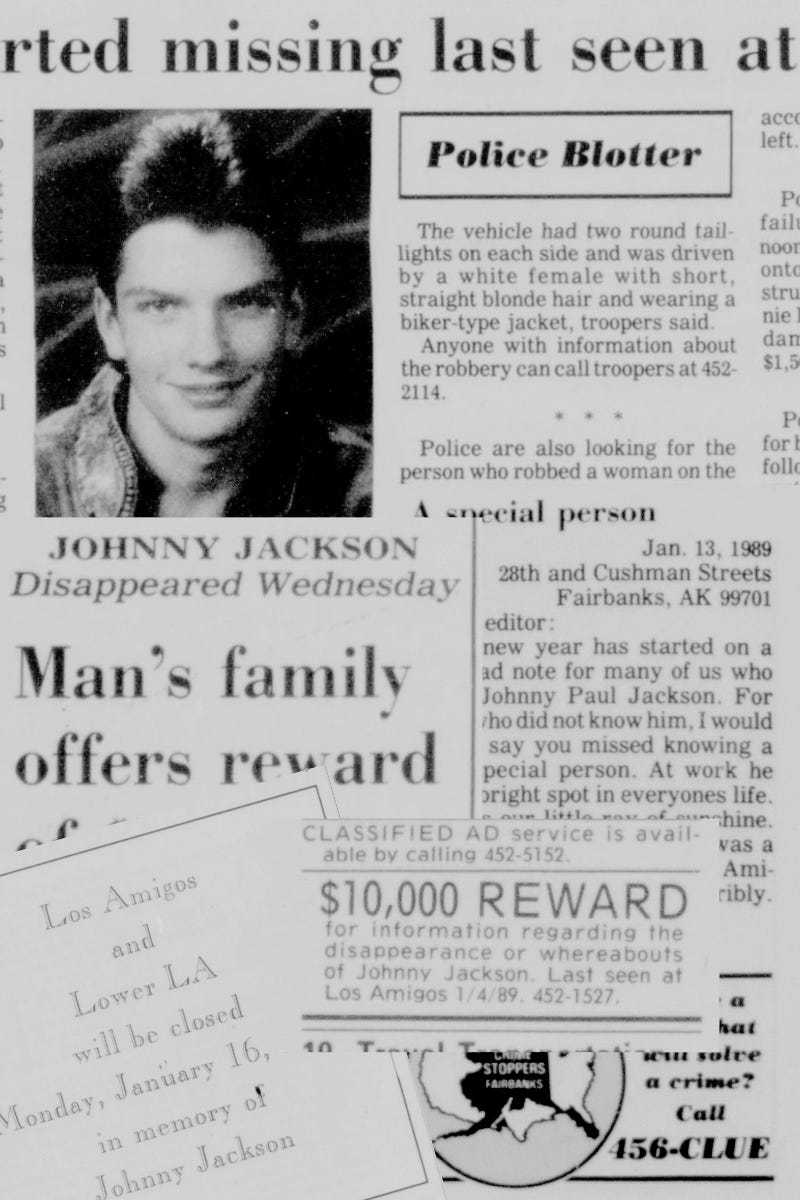
In January 1989, the Fairbanks City Police announced that 18-year-old Johnny P. Jackson was missing. Jackson was last seen leaving his job as a cook at Los Amigos, getting into a Chevy Blazer with an unknown person. He was never seen alive again.
After a tip from Perotti’s friend, police set up a recorded phone conversation, and soon after Johnny’s body was found—naked and burned—on the frozen banks of the Tanana River.
The investigation found that in the spring of 1988, a school official at Lathrop overheard Perotti’s girlfriend claim that Jackson had raped her on a date before she and Perotti had begun dating.
Though reported to the police, she declined to press charges, and Johnny denied the accusation. The case was dropped due to insufficient evidence.
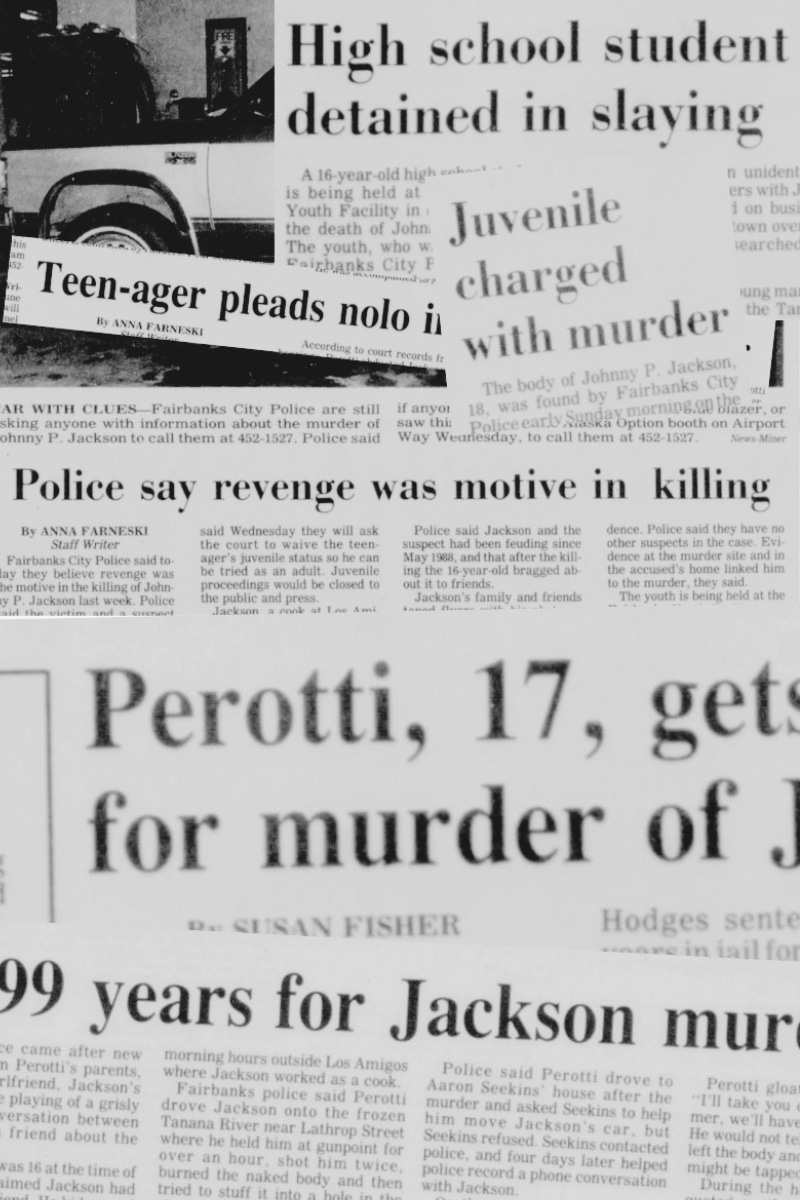
I learned from Perotti’s friend that Bryan himself questioned the rape claim’s validity but, uncertain of the details because of his girlfriend’s silence, took it personally, fueling a public vendetta against Johnny to defend her honor. Perotti told her explicitly why he murdered Jackson in a letter from prison she revealed publicly in a story titled Letters to Prison:
There were rumors that Bryan’s girlfriend recanted and told him Johnny hadn’t raped her, but it was too late. Even if Johnny wasn’t guilty of assault, in Bryan’s eyes, having sex with her was just as bad. He told me, “I didn’t kill him because he raped her. I killed him because he wouldn’t go away.”
Johnny Jackson’s life ended with two shots to the back of the head from Perotti. The killer tried to dispose of the body by fire, but when that failed, Perotti hid Jackson’s corpse in an icy embankment on the Tanana River.
Knowing a dangerous murderer had sat in my mom’s office might have faded from memory, but Perotti was jailed at Fairbanks Correctional Center, where my father worked. From his military service to driving the haul road for Alyeska Security, my dad became a Corrections Officer at F.C.C.
It was demanding work with hard people, and now I knew one inmate was a murderer who had a personal connection to my Mom, and was trapped with my Dad.
I started having nightmares about being burned alive on a frozen river. Bryan Perotti had become an actual monster in my mind, and I could not keep him away from my family.
In October 1989, before his sentencing, Perotti attempted to escape from F.C.C. by climbing to the top of the jail’s roof. Still athletic, he overpowered the man on duty there, and stole his sidearm. The guard, Larry Newman, later told me Perotti’s muscles felt like steel cables—there was no stopping him from taking his gun.
Newman was unarmed in a standoff with Perotti, with his own revolver being aimed at his chest, but was feeling better about the situation overall. Larry knew the gun wasn’t loaded. He was able to use his soft voice to talk Perotti into surrendering as his backup came and the jail went into lockdown.
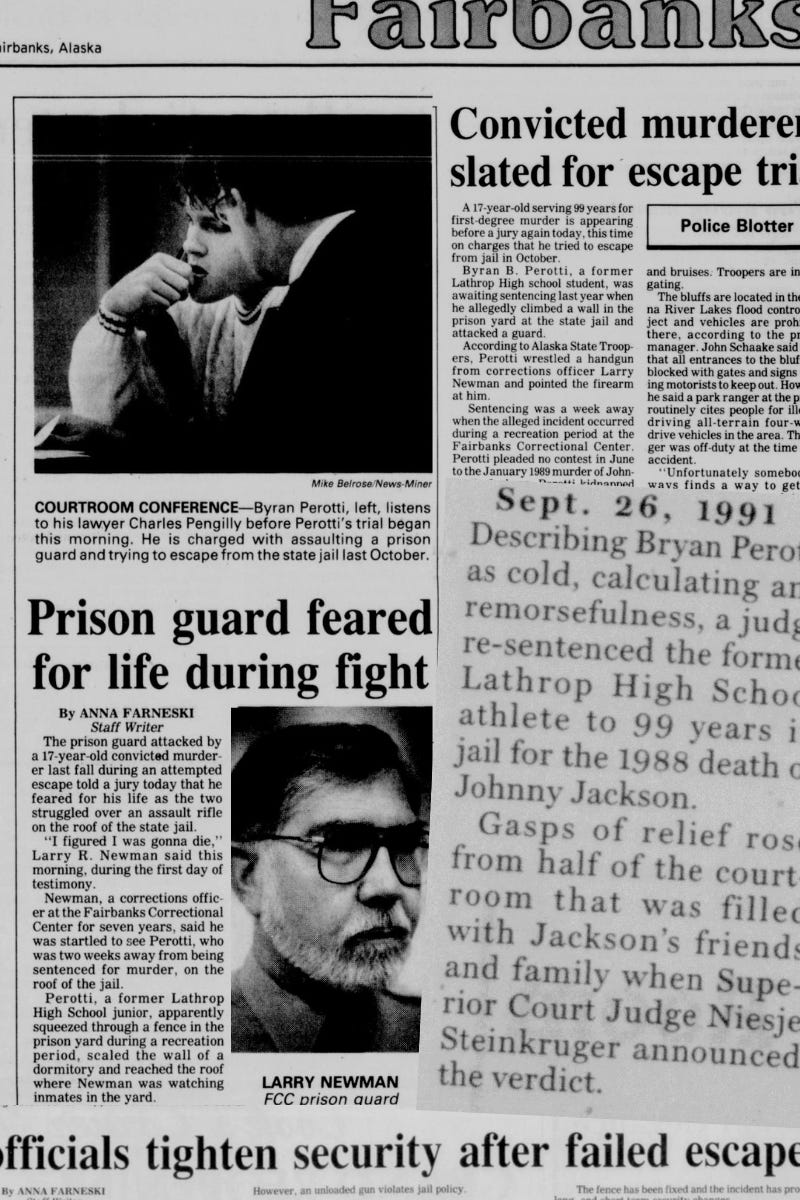
My parents met Larry Newman when they were stationed at Eielson Air Force Base in the 70s. Now a corrections officer post-military service, Dad and Larry were at F.C.C, but on opposite sides of a week on/week off schedules. Larry wasn’t supposed to be working on the roof that day; my Dad was.
He was covering a week for my Dad so we could take a family vacation in Southern California. My Dad never went on duty without a loaded sidearm, and I think Perotti would have killed him if the revolver had bullets.
When I heard about the escape, it was like I already knew it. I could feel the fear that he was coming to get us, even in California. Larry Newman retired soon after the incident, became a massage therapist, and left Alaska with his saintly wife, Donna. Our families stayed close, and I mourned his passing.
Perotti would try again to break out of jail using stolen wire cutters; this time he made it out. Not in Fairbanks though. He became the first person to escape from Spring Creek Correctional in southern Alaska. After that escape, he was transferred to a high-security prison in Arizona, where he remains today.
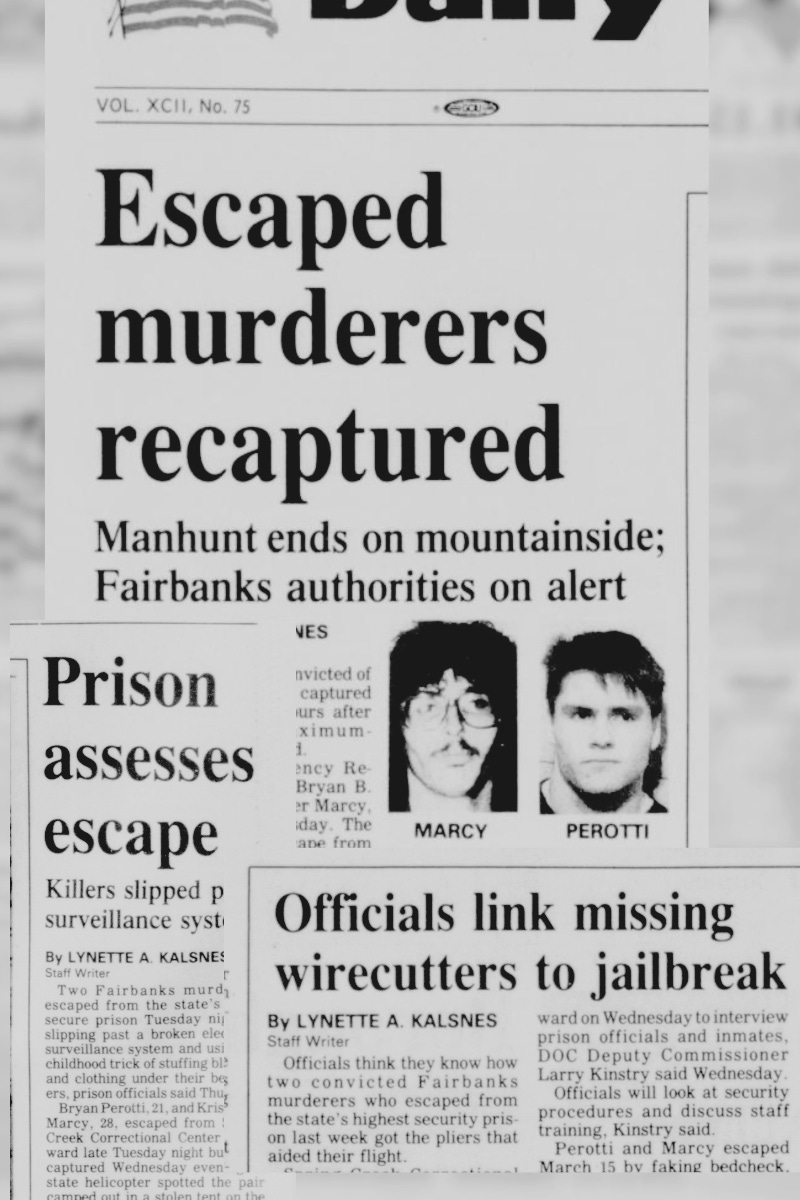
One of the first things I used the internet for was to check where Bryan Perotti was. Every couple of years, around Halloween, the old fear creeps back seeing pop-horror around, and that is why I don’t care to watch scary movies. There are real monsters in my nightmares.
Not long ago, on a getting to know you walk, my date asked me what I feared, and I probably over shared about Bryan Perotti. That evening I went searching for him again. He was still alive, incarcerated at Red Rock Correctional Center in Arizona. But this search came up with something new this time.
I found a story by Elisabeth F. Stokes reflecting on her memories of a high school murder in Fairbanks, Alaska. Stokes was friends with both the victim and the killer. She carried the murder differently than I did, but for just as long.
After reading her story, I reached out to share my perspective of how the crime affected me. In her reporting, she noted Perotti had “beautiful handwriting”, and talked about reading poetry to remind her how smart he was. It humanized him in a way I hadn’t felt before, finding out the monster could bleed too. Elisabeth personally shared with me that after she did an interview for a show about the murder, Perotti told her never to write again.
From my letter to her:
The monster in my head won’t go away until Bryan dies.
He’s just never far enough away.
Sidebar
Fairbanks covers a large area with a small community within. Playing intramural basketball, substitute dads occasionally coached our teams when one couldn’t make it.
Mark Wood was a prickly jerk by my nine- and ten-year-old standards, and his taller son was a better player than me. Wood wanted me to use my height to battle for balls, but my coordination never caught up with my growth spurts, so he was always frustrated with me, and I with him.
Until writing this, I didn’t know he was the attorney who listened to Bryan Perotti confess to Johnny Jackson’s murder. He might have gone from that room to our game or practice as the timelines match up.
I have a different perspective of Coach Wood now. He would take the bench as Judge Wood.
Take Your Love Away is a work of autofiction by S.E. Fernandez. It combines his experiences in Alaska with a dark romance tale, exploring how two people connect while facing the mental challenges of living and working in The Last Frontier. Read what this blog is about here.
You can read the first three chapters starting October 18, 2025.